Marco Balboni
Post-Doc Researcher
Department of Physics and Astronomy
Alma Mater Studiorum - Università di Bologna
I am an observational astrophysicist at the University of Bologna.
In my research I employ radio (LOFAR, MeerKAT) and X-ray (XMM Newton) observations to study cluster of galaxies, with the aim to derive the physical properties of these systems.
Currently, I am working on integrating radio and X-ray analyses with polarisation data as a part of the BELOVED project, with the final aim of constraining the evolution of the magnetic fields on large scales.
Employment
2025: Post-Doc researcher (CdR) in Astrophysics at the University of Bologna (Bologna, Italy)
Project: "Magnetic fields and thermal properties in galaxy clusters"
Supervisor: Prof. Annalisa Bonafede
2024: Post-Doc researcher (AdR) in Astrophysics at the University of Bologna (Bologna, Italy)
Project: "Thermal-non thermal study of CHEX-MATE galaxy clusters"
Supervisor: Prof. Annalisa Bonafede
Education
2025: PhD in Physics and Astrophysics at the University of Insubria (Como, Italy)
Project: "A systematic study of thermal and non-thermal properties in galaxy clusters"
Supervisor: Dr. Fabio Gastaldello, Prof. Annalisa Bonafede
2021: Master's in Astrophysics and Cosmology at the University of Bologna (Bologna, Italy)
Project: "Constraints on magnetic fields and particle acceleration in the inter-cluster bridge A399-A401"
Supervisor: Prof. Annalisa Bonafede, Dr. Gianni Bernardi
2019: Bachelor's degree in Astronomy at the University of Bologna (Bologna, Italy)
Project: "Equation of state in astrophysics"
Supervisor: Prof. Daniele Dallacasa
2016: High School Diploma at the Istituto di istruzione superiore A. Serpieri (Bologna, Italy)
Research Work
Here there is a summary of the recent research topics/activities I have been mainly involved into.
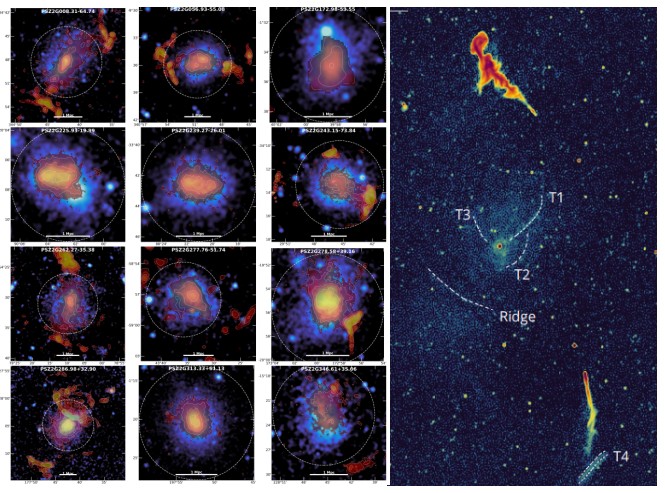
New detections of cluster diffuse radio emission with MeerKAT
New generation radio telescopes are revolutionising our view of non-thermal processes in clusters, tracing synchrotron emission (cosmic rays + magnetic fields) with unprecedented details and challenging theoretical models.
The latest, and most striking features have been found thanks to the MeerKAT radio telescope (precursor of SKA), allowing us to derive new insights on the properties of galaxy clusters and particle physics ( Fig. 1, Fig. 2).
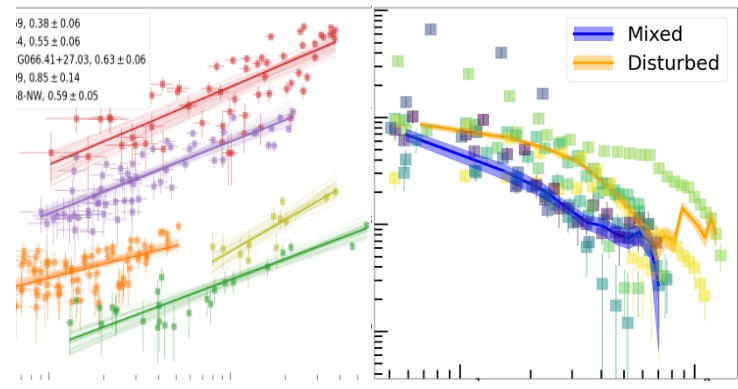
Thermal and non-thermal connection in clusters
Combining X-ray and radio observations of clusters allow us to study the complex interplay between thermal and non-thermal components in these systems. In this way, one can derive crucial information on how these two components interact and on the micro-physics of the intra-cluster medium ( Fig. 3, Fig. 4).
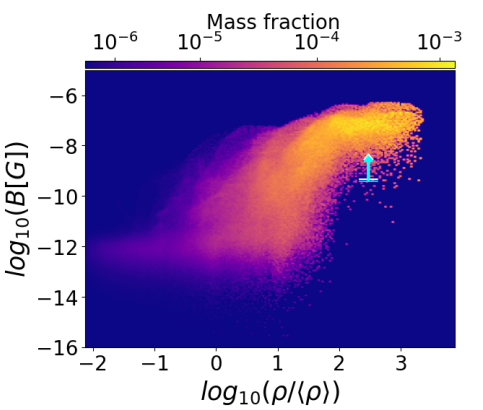
Magnetic fields on large scales
Despite their importance on many astrophysical processes, the origin and evolution of magnetic fields in the Universe are still unresolved problems. Studies on the large scale structure are crucial to investigate both the primordial properties and the amplification mechanisms of these fields during the structure formation. ( Fig. 5)

 :
: